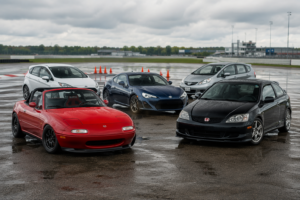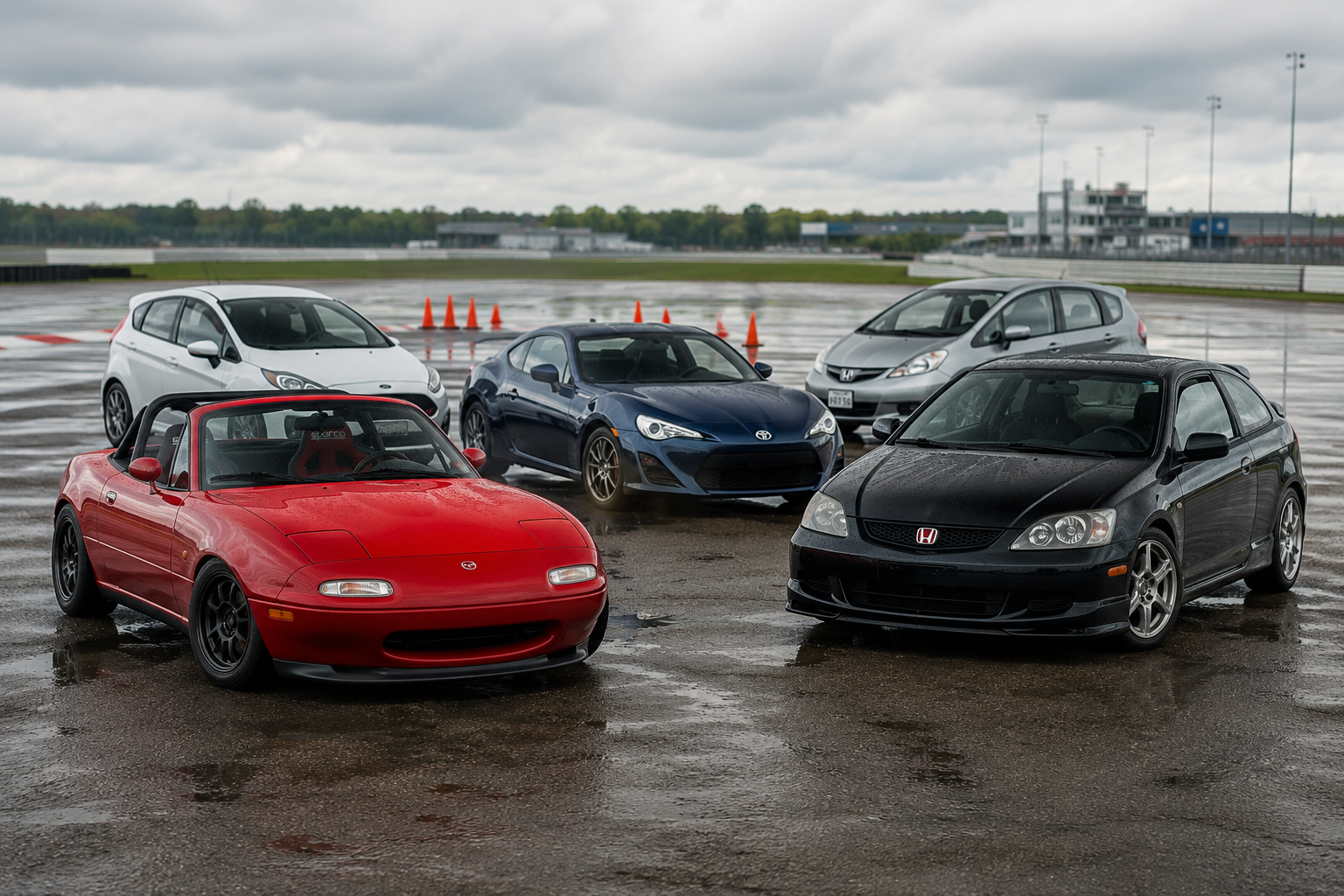
Track days aren’t just for Porsche owners. Neither is autocross. If you’ve ever watched cars fly through cones in a parking lot or attack corners at your local road course and thought, “I’d love to try that one day,” here’s the good news: you probably can.
For years, people have believed motorsport is only for those with deep pockets. That’s true if your goal is chasing trophies in professional racing. But if your goal is simply becoming a better driver, meeting fellow enthusiasts, and having the biggest grin on your face all weekend, getting started is far more affordable than most people think.
The biggest mistake beginners make isn’t buying a slow car.
It’s buying the wrong fast one.
Horsepower is exciting on YouTube. On your first track day, it’s often the last thing you need. The best beginner cars are reliable, predictable, inexpensive to maintain, and supported by huge enthusiast communities. Those are the cars that let you spend your money on seat time instead of tow trucks.
Here’s what we’d buy.
What Makes a Great Beginner Track or Autocross Car?
Before talking about specific models, let’s talk about what actually matters.
A good beginner car should be:
- Reliable enough to survive repeated hard driving
- Cheap to repair when something eventually wears out
- Light on brakes and tires
- Easy to find parts for
- Supported by a strong aftermarket
- Forgiving when you make mistakes
Notice what’s missing?
Horsepower.
The driver who learns momentum in a 140-horsepower car often becomes faster than the driver who starts in a 500-horsepower monster.
1. Mazda MX-5 Miata (NA, NB, NC)
If you’ve spent five minutes around autocross or track-day enthusiasts, you’ve already heard it.
“Miata is always the answer.”
There’s a reason people keep saying it.
The Miata isn’t the fastest car on the straight. It doesn’t need to be.
It teaches weight transfer.
It teaches smooth steering.
It teaches throttle control.
Because the limits are approachable, beginners can actually explore them safely instead of constantly fighting the car. The lightweight chassis also means brake pads, tires and fuel last much longer than they would on heavier performance cars. It’s consistently recommended by track-day publications and enthusiast communities because of its balance, low operating costs, and massive aftermarket support.
Pros
- Huge aftermarket
- Excellent reliability
- Cheap consumables
- Massive community support
Things to know
If you’re planning frequent road-course events, many organizers require older convertibles to have an approved roll bar. Always check your event rules before registering.
2. Honda Civic Si
Front-wheel drive doesn’t make a car boring.
It makes mistakes cheaper.
The Civic Si has introduced thousands of drivers to grassroots motorsport for one simple reason, it just keeps working.
Parts are everywhere.
Every mechanic knows them.
Every forum has already answered your questions.
When something breaks, you’re usually fixing it instead of searching for discontinued components.
The Civic also teaches momentum driving incredibly well. Instead of relying on horsepower, you’ll learn braking points, corner speed and clean driving lines.
Those skills transfer to every performance car you’ll ever own.
3. Acura RSX Type-S
Think of it as the Civic’s slightly cooler cousin.
The RSX Type-S combines Honda reliability with one of the best manual gearboxes ever fitted to a front-wheel-drive car.
High-revving VTEC engines reward smooth driving, while the hatchback layout makes it surprisingly practical if you daily drive the same car.
Finding clean examples isn’t as easy as it used to be, but they’re still worth considering if you come across an unmodified one.
4. Toyota 86 / Scion FR-S / Subaru BRZ
If your budget stretches a little further, these cars deserve serious attention.
Everything about them was designed to make learning fun.
Rear-wheel drive.
Excellent balance.
Low centre of gravity.
Predictable handling.
They’re often recommended as one of the best modern beginner track platforms because they combine daily-driver practicality with forgiving chassis dynamics and a huge aftermarket.
They’re not outrageously powerful.
That’s exactly why they’re so rewarding.
5. Honda Fit
This surprises people.
Until they drive one.
The Fit has become something of a hidden gem in grassroots motorsport because it’s light, reliable, inexpensive to own and incredibly forgiving.
No, it won’t dominate the straightaways.
It doesn’t have to.
You’ll spend your day learning how to carry speed through corners, which is exactly what beginners should be practicing anyway.
Experienced autocross competitors frequently recommend the Fit as one of the cheapest ways to maximize seat time without burning through expensive consumables.
6. Toyota Corolla XRS
This one deserves more attention than it gets.
The Corolla XRS won’t win beauty contests or social media likes.
What it will do is start every morning, rev happily, and take abuse better than many purpose-built sports cars.
The high-revving 2ZZ-GE engine gives it genuine personality, while Toyota reliability keeps ownership costs sensible.
Finding a clean one is becoming harder, but it’s still one of the most overlooked budget enthusiast cars.
Check out our article on Corolla XRS here.
7. Ford Fiesta ST
If you’re shopping in a slightly newer price range, don’t overlook the Fiesta ST.
It’s light.
It’s playful.
It loves changing direction.
Most importantly, it’s one of those rare cars that makes even slow laps feel entertaining.
Maintenance costs remain reasonable compared with heavier turbocharged performance cars, making it an excellent stepping stone into regular track events.
Don’t Spend Your Entire Budget on the Car
Here’s something first-time track drivers rarely hear.
Buying the car is usually the cheapest part.
Your first event will probably also include:
- Fresh brake fluid
- Good brake pads
- Quality tires
- Engine oil
- Helmet
- Entry fee
- Fuel
Those are not glamorous purchases.
They’re the ones that actually keep you on track.
Many experienced drivers would rather own a $6,000 car with excellent tires than a $20,000 car wearing bargain rubber.
That’s good advice.
Modifications Can Wait
One of the biggest traps in car culture is believing your first modification should be horsepower.
It shouldn’t.
Spend your money in this order:
- Maintenance
- Tires
- Brake pads
- Brake fluid
- Driver experience
Only after you’ve attended several events should you start thinking about suspension upgrades or additional power.
The fastest drivers at local events are often the ones who have spent years improving themselves instead of constantly modifying their cars.
Autocross vs. Track Days
If you’ve never driven competitively before, autocross is the perfect place to begin.
Events are inexpensive.
Speeds are lower.
Mistakes usually mean knocking over a traffic cone instead of visiting the gravel trap.
Track days offer more speed and longer sessions, but they also place greater demands on brakes, tires and cooling systems.
Many enthusiasts start with autocross before moving on to full road-course events, and it’s a progression that makes a lot of sense.
The Best Car Is the One You Can Afford to Drive Again
There’s a saying you’ll hear in almost every paddock.
“Seat time beats horsepower.”
It’s true.
The perfect beginner track car isn’t the one with the biggest turbo.
It isn’t the one making the most noise in the parking lot.
It’s the one that lets you come back next month.
Because every lap teaches something new.
Every event builds confidence.
And before long, you’ll discover something surprising.
The most addictive part of grassroots motorsport isn’t winning.
It’s getting just a little bit better every time you buckle your helmet.
Read the article where we took a basic Corolla to a real race track here.